
The House on the Roman Road: a Granite House in Campeã, Vila Real
Before the house, there was the road.
Campeã sits at 727 metres on the eastern slope of the Marão, the mountain that for two thousand years stood between Porto and Trás-os-Montes. Everyone who crossed it came through here: Roman surveyors, medieval pilgrims, muleteers with salt and dried fish, Napoleon's soldiers. In the heart of the village, between the old common square and the path to the church, stands a granite house. The lane beside it is still called the Caminho Romano.

The road over the mountain
The archaeologist Pedro Soutinho has traced the road that climbed from the Tâmega over the Marão on its way from Bracara Augusta, Roman Braga, to the Douro. In the Vale da Campeã it met a second road coming down from Chaves, and the two divided again towards the river crossings at Moledo and Régua. The route is probably older than Rome: Neolithic and Iron Age sites line its course.
Soutinho places a possible mutatio, a Roman staging post where horses were changed, at Vendas da Campeã, by the chapel of São Roque. The name of the place says the rest. Vendas means inns, and in 1134 Afonso Henriques, soon to be Portugal's first king, granted a charter of privilege to the albergaria do Marão, a shelter for travellers that stood in Campeã.
An arch for the dead
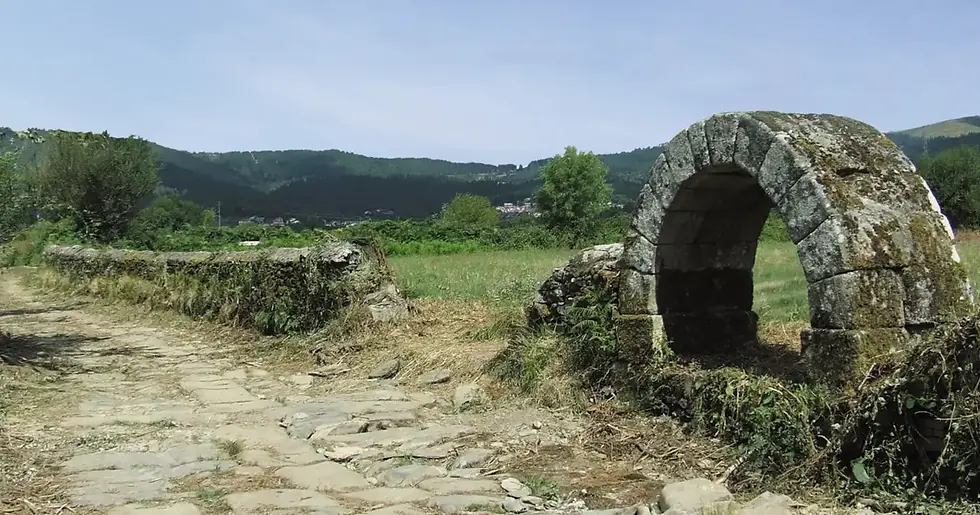
A short stretch of the old paving survives at Campeã, the Calçada do Arco, and it takes its name from what stands over it: a granite arch that has nothing to do with Rome. According to the historian Vítor Nogueira, it was raised in the late Middle Ages with a funerary and commemorative purpose. Medieval memorial arches of this kind are among the rarest monuments in Portugal; only a handful still stand, among them the memorials of Ermida, Sobrado and Alpendorada, always on old roads.
In 2026 the municipality of Vila Real classified the whole ensemble as heritage of municipal interest: the Roman-medieval paving, the memorial arch and an eighteenth-century wayside cross of the Senhor da Boa Hora. A road, a tomb and a prayer, in a few hundred metres of granite.
A road, a tomb and a prayer.
The roughest road in the province
The Marão never made it easy. In 1796 the road was described as the roughest in the province. In May 1809, during the second French invasion, there was fighting on the climb from Amarante, and the Portuguese cut the newer road to slow Marshal Soult's troops, sending traffic back onto the old one. In 1873 the historian Pinho Leal wrote of travellers dying in the snow between Campeã and Ovelha. Oxen were hired to haul coaches up the slope, and the descent could be faster than anyone wished.
The new royal road of the 1860s eased the gradients, and by the end of the century the Douro railway had taken the traffic away from the mountain altogether. Campeã kept its inns' name, its chapels and its granite, and became what it is today: a village of stone at the top of the climb.
On the Marão, every old house is a house on the road.
A granite house on the square
The house belongs to the oldest tradition of Trás-os-Montes: a loja below, where animals, carts and harvests were kept, and the family above. It was already on the property registers in the 1930s, and the land registry describes it bounded by the village's common square to the north and by the path to the church to the south. It is built of dressed granite, with walls some sixty centimetres thick.
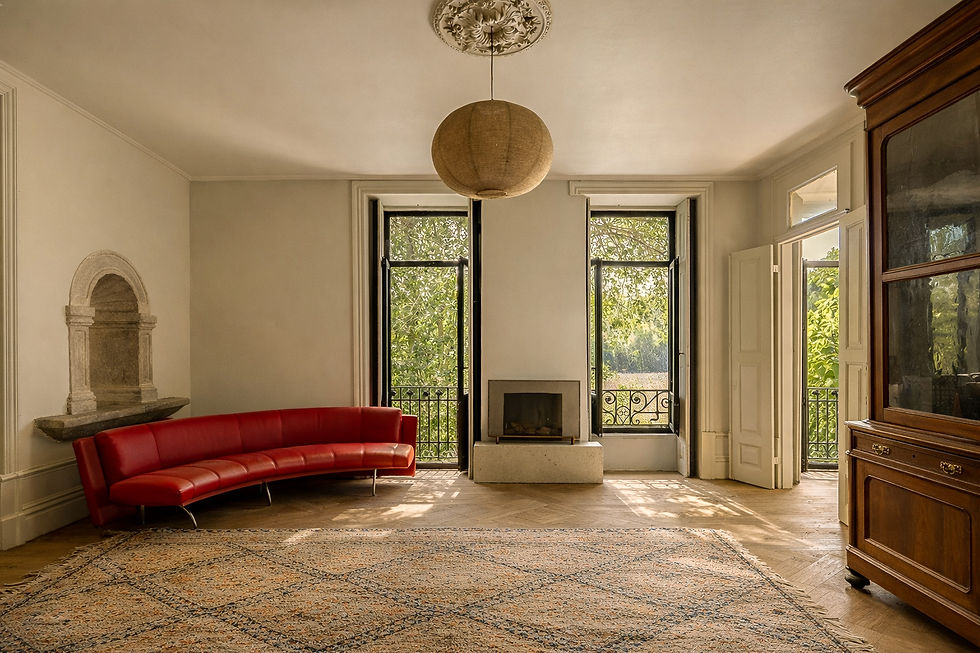
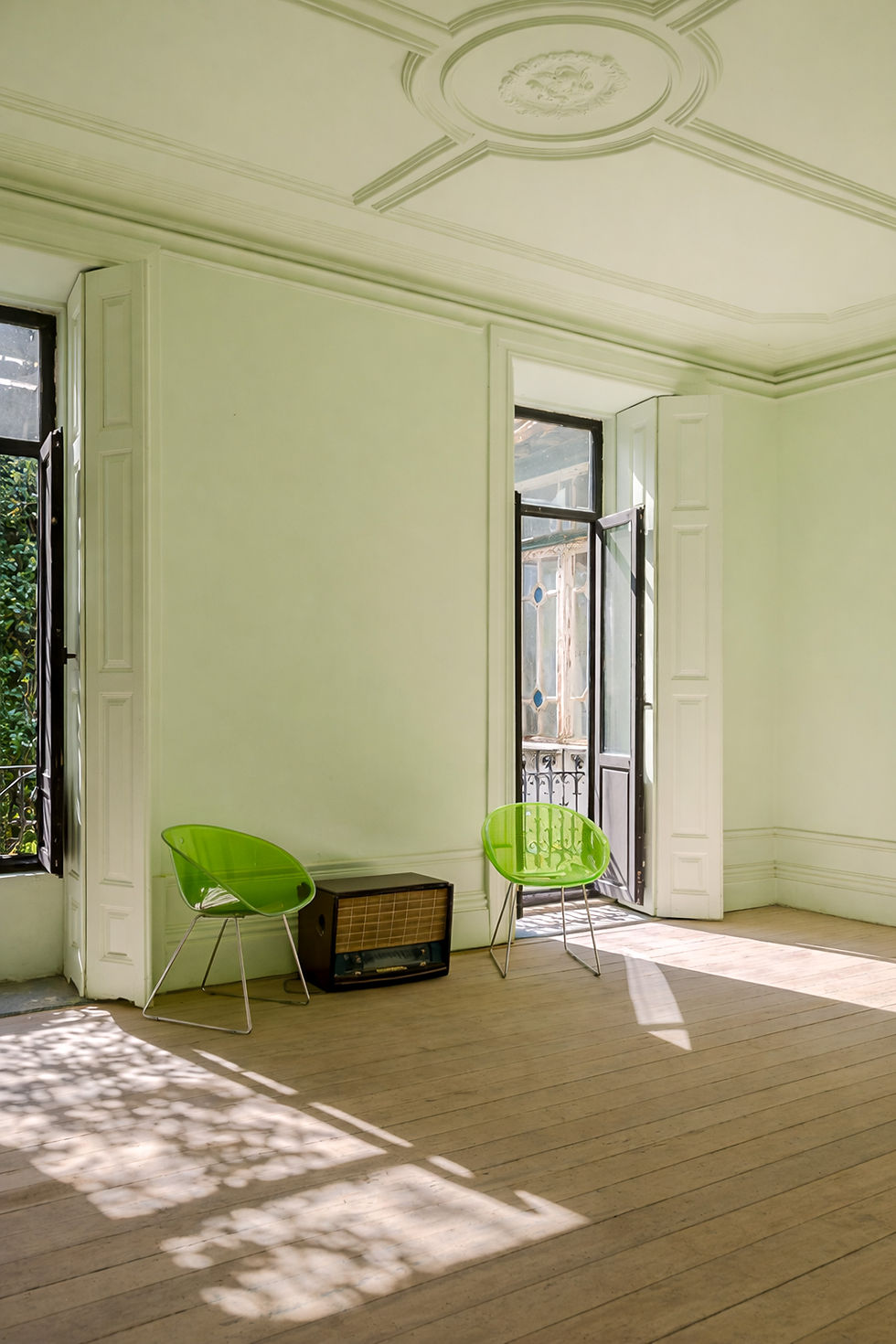
Upstairs, the house turns gracious. Tall sash windows and French doors open onto iron balconies, ceilings keep their original plasterwork, and period chimneypieces anchor the principal rooms. One salon has a fountain set into its stone wall.
At the back, the old kitchen keeps its exposed roof trusses and the scale of a working house, where bread was baked and winters were spent by the fire.

The house today
The present owners bought the house to bring it back, and the revival has begun: floors restored room by room, the essentials put right. The main house has around 767 m² of gross built area on a plot of some 2,700 m², with more than 2,000 m² of mature garden, terraces and a pool. Two small stone houses on the grounds, now in ruins, wait for a use: a guest house, a studio. The rest is a matter of taste and time.
The house is for sale through Wiseguys Properties: see Old Stone House. For another northern house with its history written in granite, read The Comendador's House.
Frequently asked questions
Is there a Roman road in Campeã?
Yes. Archaeologists trace the Roman road from Braga to the Douro across the Marão and through the Vale da Campeã. A paved stretch, the Calçada do Arco, survives in the village. Its paving is described as Roman-medieval.
What is the arch at Campeã?
A granite memorial arch built in the late Middle Ages with a funerary and commemorative purpose, according to the historian Vítor Nogueira. Only a handful of medieval memorial arches survive in Portugal.
Is the ensemble protected?
Yes. In 2026 the municipality of Vila Real classified the paving, the arch and the eighteenth-century wayside cross of the Senhor da Boa Hora as heritage of municipal interest.
How old is the house?
It was already recorded in the property registers in the 1930s and may be older. It is built of dressed granite in the traditional two-level form of Trás-os-Montes.
Is the house for sale?
Yes, through Wiseguys Properties, as Old Stone House.
Further reading: Renovating a House in Portugal: Old Walls, New Rules, and Buying Land in Portugal: BUPi, the Land Registry and Rural Plots.
Sources: Pedro Soutinho, "A Serra do Marão na rede viária romana", in Povoamento e vias de comunicação ao longo da História, vol. 1, Biblioteca Municipal de Vila Real (2021); Vítor Nogueira, Seis calçadas lajeadas do concelho de Vila Real, cited by the Câmara Municipal de Vila Real and Lusa (2026); Vias Romanas em Portugal, "Calçada do Arco em Campeã" (2020); Rota do Românico, Memorial da Ermida; A. Pinho Leal, Portugal Antigo e Moderno (1873). Photography: Wiseguys Properties; arch: Câmara Municipal de Vila Real.

Comments