
The Theatre Garrett Asked For: the Teatro Portalegrense
A curtain that first rose in 1858, and a city that wanted its own stage.
In the historic centre of Portalegre, on the Largo Visconde de Cidrais, a pale façade crowned by a triangular pediment hides one of the oldest surviving theatres in Portugal. Behind its arched balcony windows lies a horseshoe of boxes in three tiers, gilded stucco and a painted ceiling of clouds and figures. This is the Teatro Portalegrense, the city's first purpose-built theatre.

Garrett's idea of a theatre for every city
In the 1830s, the writer Almeida Garrett was charged by the liberal government with reforming Portuguese theatre. His work led to the national theatre in Lisbon, the Teatro Nacional D. Maria II, which opened in 1846, and to an idea that spread across the country: that every important city deserved a proper hall for drama.
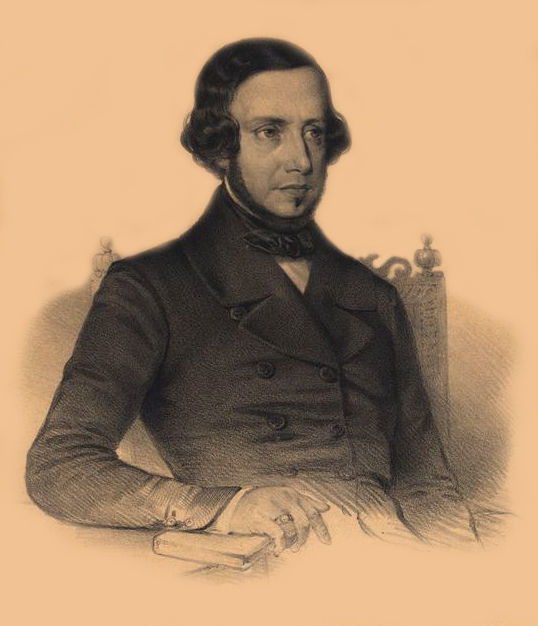
Portalegre took up the challenge. In 1850 a joint-stock company was formed to build and run the city's first theatre. The first stone was laid on 14 July 1854, to a design directed by José de Sousa Larcher, and on 20 June 1858 the hall opened to the public with a play by Garrett himself: O Alfageme de Santarém, a historical drama.
Garrett's play opened the house he had, in a sense, asked for.
A horseshoe of boxes
The building is a compact block with a pediment and arched windows on its principal floor. Inside, the auditorium follows the Italian model: three tiers of boxes curve around the stalls, framed by gilded stucco, under a painted ceiling. In 1886 new works added three ground-level boxes, renewed the linings and upholstery of the boxes and partly replaced the ceiling paintwork. Further works followed in 1906 and 1913, and in 1906 the first cinematograph sessions were held here.

A painter from Portalegre
The ceiling of the hall is attributed to Benvindo Ceia (1870–1941), a decorative painter born in Portalegre. Trained at the Lisbon school of fine arts under masters such as Silva Porto and Veloso Salgado, he painted for the Theatro Circo in Braga and the theatre in Estremoz, for the Parliament at São Bento and for Lisbon cafés such as the Martinho da Arcada, and won a gold medal at the 1929 Ibero-American Exposition in Seville.

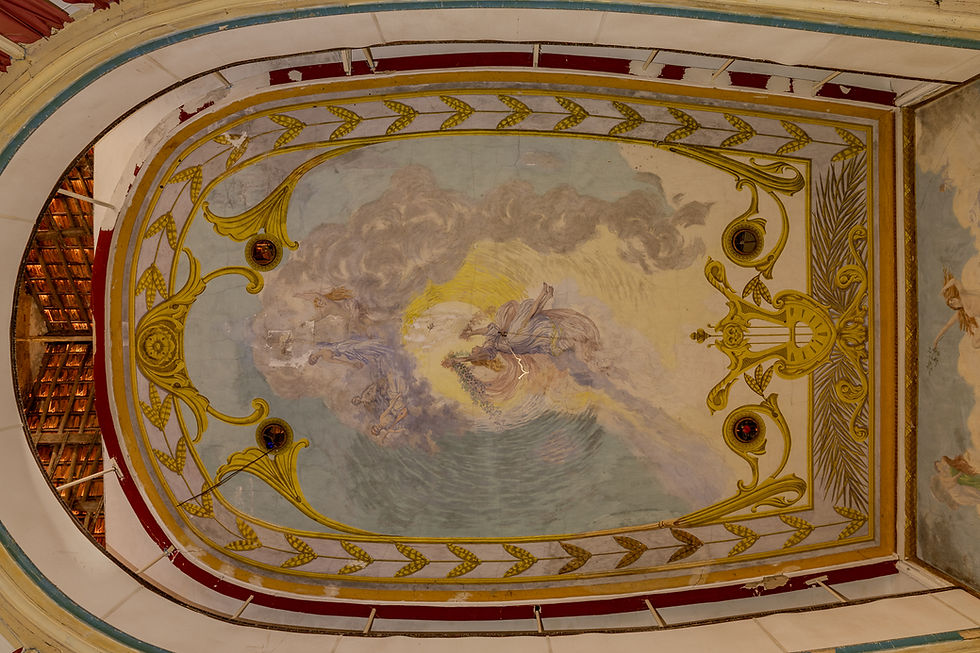
Clouds and gilded scrolls above the stalls, painted by a son of the city.
Régio's students and a last bow
The poet and playwright José Régio taught for more than three decades at the Liceu de Portalegre. In 1935 his graduating students staged here his play Sonho de uma Véspera de Exame; among the young actors was Artur Semedo, who went on to a career as an actor and film director.
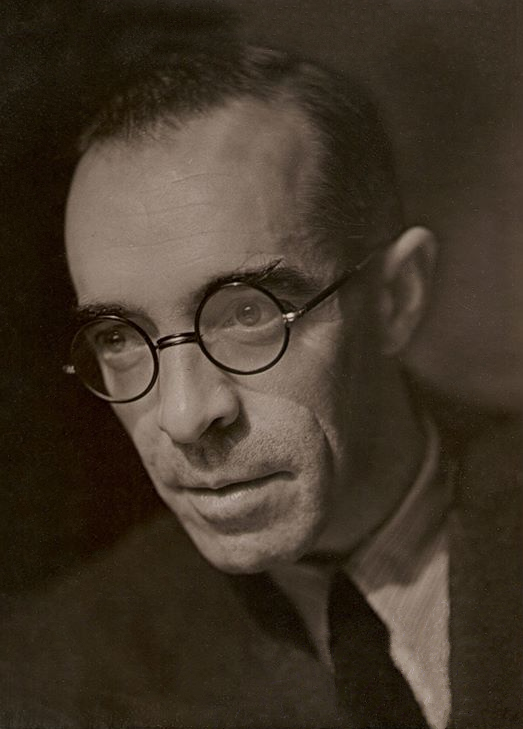
By the 1940s the building was in poor condition, and the theatre inspectorate allowed it to work only under heavy restrictions. Yet in 1985, according to local accounts, the great actress Amélia Rey Colaço made her last stage appearance here, in Régio's El-Rei Sebastião, in homage to the playwright, who had died in 1969. It was the last performance the theatre would see.

The theatre today
Closed for decades, the Teatro Portalegrense was later used as a roller-skating rink and as the seat of a sports club. It stands within Portalegre's heritage protection area, with more than 2,000 m² over several floors: the auditorium, a salon with arched windows on the principal floor, foyers and staircases. It awaits restoration and a new use, subject to the necessary approvals.


The theatre is for sale through Wiseguys Properties: see the historic theatre in Portalegre. For another story from the Portalegre district, read about the house where Nisa embroiders.
Frequently asked questions
When did the Teatro Portalegrense open?
The first stone was laid on 14 July 1854 and the theatre opened on 20 June 1858 with Almeida Garrett's O Alfageme de Santarém.
Who designed it?
The project was directed by José de Sousa Larcher. The theatre was built by a joint-stock company formed in 1850.
Who painted the ceiling?
The ceiling is attributed to Benvindo Ceia (1870–1941), a decorative painter born in Portalegre.
What is its link to José Régio?
In 1935 students of the Liceu de Portalegre, where Régio taught, staged his play there, and in 1985 his El-Rei Sebastião was performed there in his memory.
Is the theatre for sale?
Yes, through Wiseguys Properties. Any restoration or new use is subject to the necessary approvals.
Further reading: Listed Buildings in Portugal: Buying a Classified Property.
Sources: e-cultura, Evocação dos Teatros de Portalegre; Musorbis, Portalegre e os seus auditórios; Observador (2019); ZAP (2022); Cinemas do Paraíso (2024); Montalvo e as Ciências do Nosso Tempo, Benvindo Ceia (2010). Photographs of the theatre: Wiseguys Properties. Portrait of Garrett after Guglielmi.


Comments