
Ribeiro Telles and the Garden of the Quinta, Lumiar
A garden is not decoration. It is a landscape at the scale of a house.
Gonçalo Ribeiro Telles spent his life saying that Portugal's landscape was not scenery but a living system, to be read and cared for. In 1970, the same years in which his garden for the Gulbenkian Foundation was growing into Lisbon's most loved, he was asked to redraw a much older one: the garden of the Quinta de São Sebastião, at Paço do Lumiar.

The landscape architect
Ribeiro Telles was born in Lisbon in 1922 and trained in agronomy and landscape architecture at the Instituto Superior de Agronomia. From 1961, with António Viana Barreto, he designed the garden of the Calouste Gulbenkian Foundation, which earned the Valmor Prize in 1975. He went on to draw Lisbon's green corridors, to serve as Minister for Quality of Life, and to help create the national ecological and agricultural reserves that still shape the country's land. In 2013 he received the Sir Geoffrey Jellicoe Prize, the highest honour in his profession.

An old garden, redrawn
The garden he found at Lumiar was already old. Inventories describe an eighteenth-century pleasure ground of statues, fountains, tanks and tiled walls, with a tiled bench dated 1715. After a major restoration of the house in 1965, its owner commissioned Ribeiro Telles in 1970 to rethink the garden around it.
The garden today is a sequence of rooms rather than a view: a curved bench of blue-and-white tile around a stone basin, a tank that doubles the pavilions in its water, a classical loggia, a colonnade, steps and urns under cypress and plane trees. It is the grammar of the Portuguese garden, shade, water and tile, which Ribeiro Telles defended all his life.

Shade, water and tile.

The Portuguese garden is made of shade, water and tile, and it is meant to be lived in.
To know exactly which paths and beds are his, one would have to consult the 1970 project itself. The heritage record is clear, though, about the authorship of the remodelling, and about what he worked with: a garden that had been growing for two hundred years.
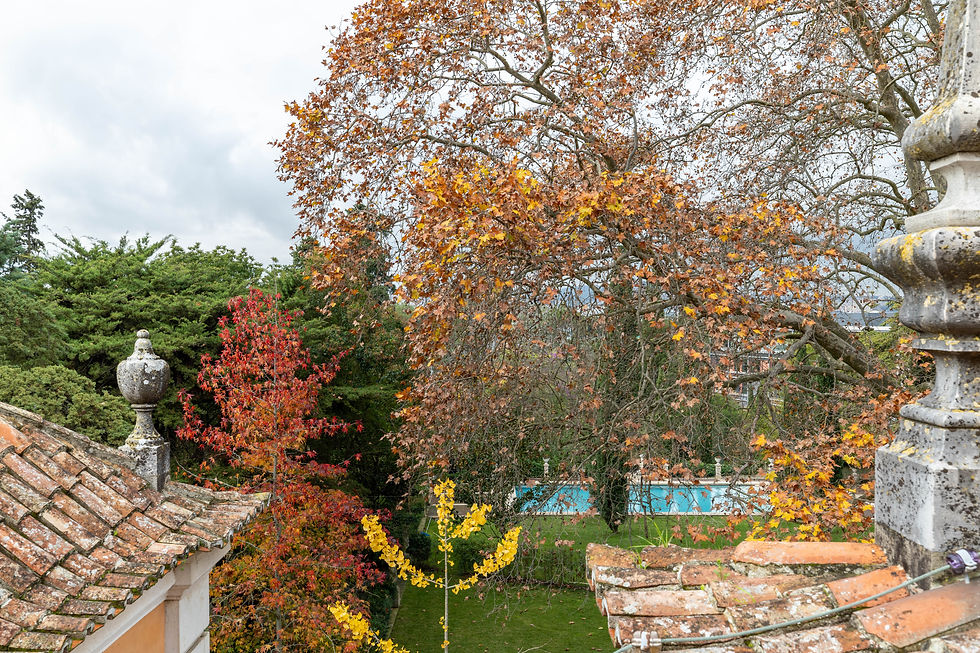
The garden today
The palace kept a garden of some 2,780 m², with its tanks, pavilions and tile. The earlier history of the estate is told in Before Lino, the 1920 rebuilding of the house in Raul Lino rebuilds a royal quinta, and the neighbourhood in Paço do Lumiar, a village of quintas.
The palace is for sale through Wiseguys Properties: see Garden of Eden.
Frequently asked questions
Who was Gonçalo Ribeiro Telles?
A Portuguese landscape architect and politician (Lisbon, 1922–2020), designer with António Viana Barreto of the Gulbenkian garden and winner of the Sir Geoffrey Jellicoe Prize in 2013.
What did he design at Paço do Lumiar?
In 1970 he designed the remodelling of the garden of the Quinta de São Sebastião, according to the national heritage inventory.
What is a Portuguese garden?
A garden of terraces and enclosed spaces, built around shade, water in tanks and fountains, and walls and benches of azulejo.
How old is the garden?
It dates from the eighteenth century; a tiled bench once carried the date 1715.
Is the property for sale?
Yes, through Wiseguys Properties, as Garden of Eden.
Further reading: Lisbon Neighbourhoods: Where to Live, Read Through Architecture.
Sources: SIPA – Sistema de Informação para o Património Arquitectónico, "Jardins da Quinta de São Sebastião" (record 10421); Jardins Históricos de Portugal; Rota do Paço do Lumiar, Centro Cultural da Ponte (2025). Fundação Calouste Gulbenkian. Photography: Wiseguys Properties.


Comments