
Raul Lino Rebuilds a Royal Quinta: the Portuguese House in Lumiar
Updated: 1 day ago
The prophet of the new Portuguese house, called in to save an old one.
By 1920 Raul Lino was the most articulate architect in Portugal, the man who had spent two decades asking what a Portuguese house should be. That year the Roxo family asked him a different question: what to do with an old one. The house was the Quinta de São Sebastião, at Paço do Lumiar, an estate of the age of King João V that had seen better days.

An architect between Windsor and the Alentejo
Lino was born in Lisbon in 1879 and educated abroad: at school in Windsor, then in Germany, in the studio of the architect Albrecht Haupt, a scholar of Portuguese Renaissance building. He came home with a European training and a question. Travelling the country, beginning with the Alentejo, he studied the way ordinary Portuguese houses met the sun, the slope and the street.

The answer became a doctrine. In A Nossa Casa (1918), then in A Casa Portuguesa (1929) and Casas Portuguesas (1933), he argued for houses rooted in climate and custom: deep eaves, whitewashed walls, porches, tile, gardens that belonged to the house. His own work, more than seven hundred projects, from the Casa dos Patudos in Alpiarça to the Teatro Tivoli in Lisbon, put the argument in stone.
A doctrine of eaves, porches and tile.
Rebuilding, not inventing
At Lumiar the brief was different. The heritage inventory records that Lino directed major reconstruction works on the house in 1920, for the Roxo family, on an eighteenth-century estate with royal arms on its rear façade and a garden of tile. For an architect who wrote about the Portuguese house, it was a chance to work on the real thing.
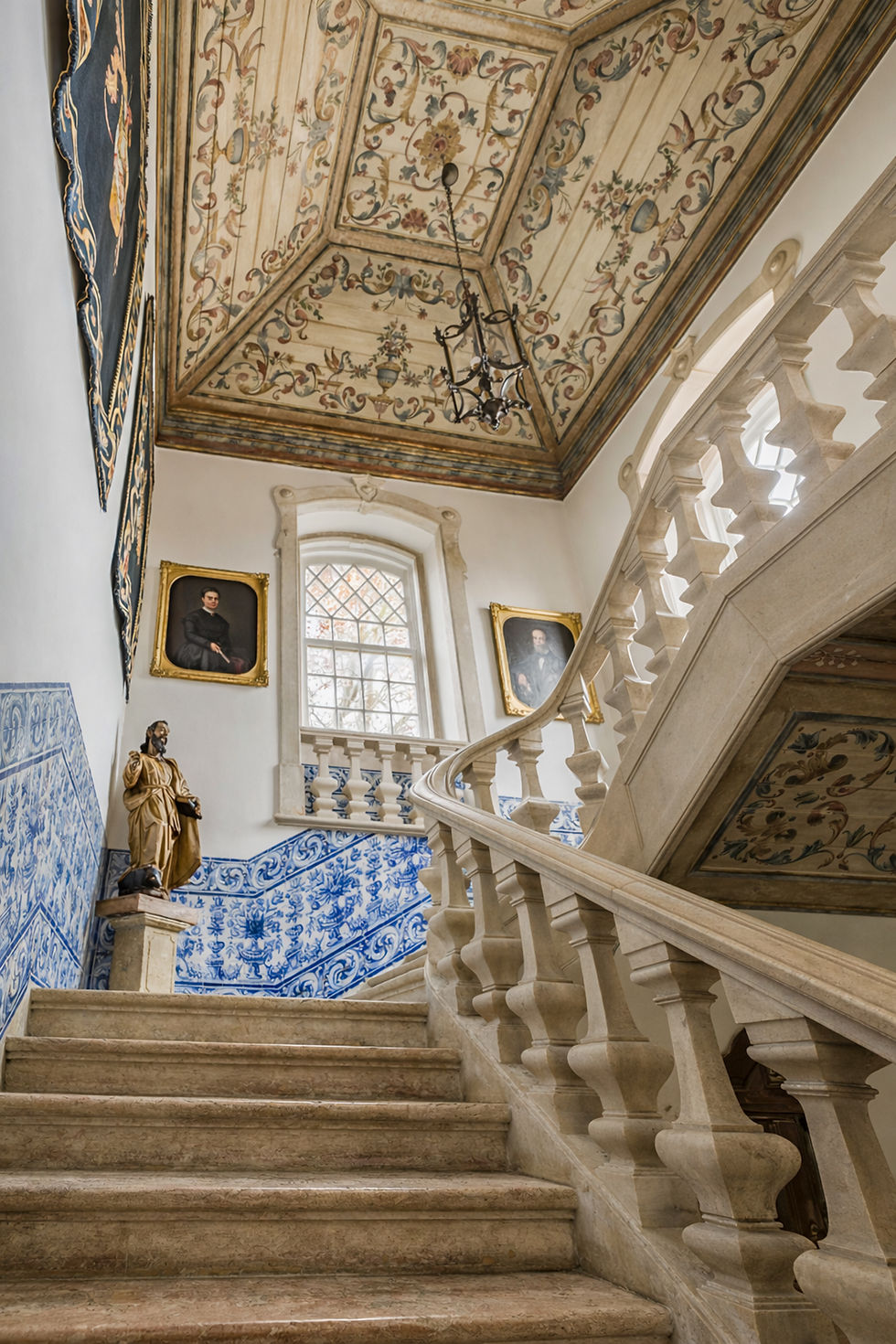
The house today reads as one long, calm composition: ochre walls, stone dressings, tall windows, a portico onto the garden and, at the centre of one front, a figurative tile panel between two arched windows. Inside, a stone staircase climbs between blue-and-white tiles; ceilings are painted; one room is lined in carved wood.
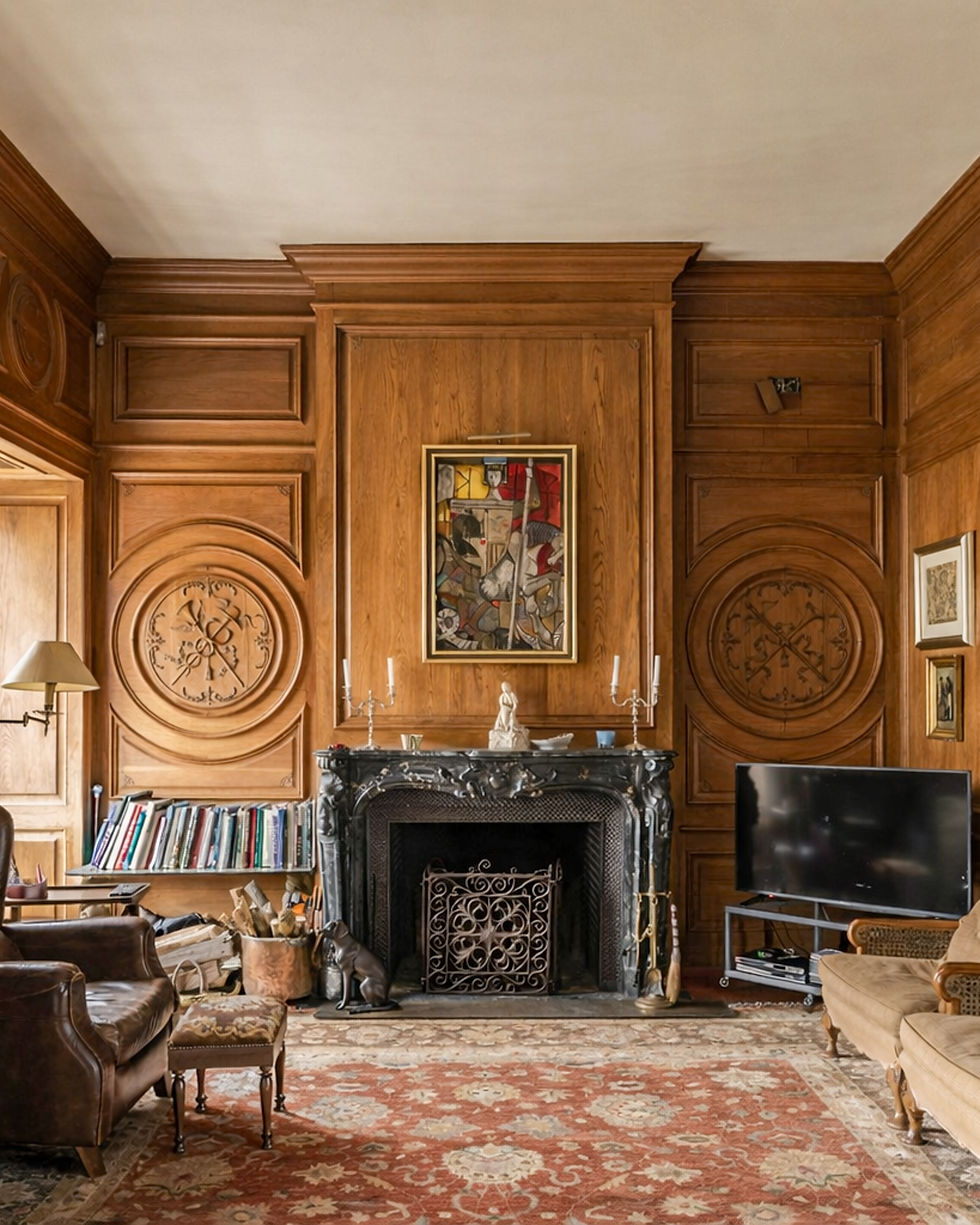
How much of this is Lino's hand, and how much the eighteenth century's, is a question for the archives: Lino's papers are held by the Art Library of the Calouste Gulbenkian Foundation, and the later restoration of 1965 added its own layer. What the record does say is that the house entered its modern life through his 1920 works.
For Lino, a house was not a style. It was a way of living in a place.
The house today
Half a century after Lino, the garden was redrawn by the landscape architect Gonçalo Ribeiro Telles: that story is here. The earlier history of the quinta is told in Before Lino, and its neighbourhood in Paço do Lumiar, a village of quintas.
The palace is for sale through Wiseguys Properties: see Garden of Eden.
Frequently asked questions
Who was Raul Lino?
A Portuguese architect (Lisbon, 1879–1974), trained in England and Germany, known for his writings and buildings on the Portuguese house, including A Nossa Casa (1918) and Casas Portuguesas (1933).
What did Raul Lino do at Paço do Lumiar?
In 1920 he directed major reconstruction works at the Quinta de São Sebastião for the Roxo family, according to the national heritage inventory.
What is the 'casa portuguesa'?
Lino's idea of a house rooted in Portuguese climate and custom, with eaves, porches, tile and gardens, defended in his books and built in hundreds of projects.
Where are Raul Lino's archives?
His papers are held by the Art Library of the Calouste Gulbenkian Foundation in Lisbon.
Is the house for sale?
Yes, through Wiseguys Properties, as Garden of Eden.
Further reading: Renovating a House in Portugal: Old Walls, New Rules, and Lisbon Neighbourhoods: Where to Live, Read Through Architecture.
Sources: SIPA – Sistema de Informação para o Património Arquitectónico, "Jardins da Quinta de São Sebastião" (record 10421); Jardins Históricos de Portugal; Rota do Paço do Lumiar, Centro Cultural da Ponte (2025). Biblioteca de Arte, Fundação Calouste Gulbenkian. Photography: Wiseguys Properties; portrait of Raul Lino: Arquivo Histórico de Almada.


Comments