
Jean-Claude Nicolas Forestier, the Gardener Who Drew Cities
He was trained to manage forests. He spent his life putting them inside cities.
Jean-Claude Nicolas Forestier is one of the quiet authors of the twentieth-century city. The rose garden at Bagatelle, the tiled glorietas of Seville, the terraces of Montjuïc, a park system for Havana: all came from the same hand, and the same conviction, that a garden is not an ornament but part of how a city works. His work reached Portugal too.
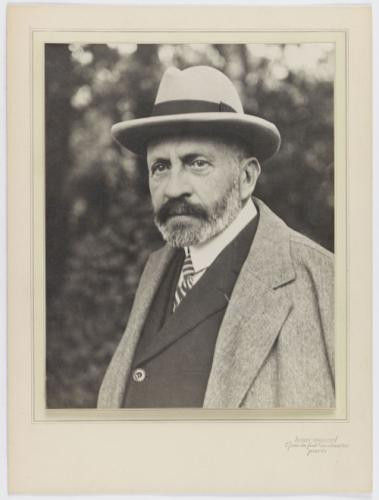
Paris: an engineer among the trees
Forestier was born in Aix-les-Bains in 1861. He studied at the École polytechnique and then at the forestry school in Nancy, and in 1887 joined the City of Paris, inside the parks service that Adolphe Alphand had built for Haussmann. He would stay forty years.
He was made conservator of the Bois de Vincennes in 1889 and, in 1898, of the Bois de Boulogne and the western promenades of Paris, where he also laid out the avenue de Breteuil. In 1904 he fought to save the Champ-de-Mars from development and redesigned the gardens below the Eiffel Tower. Between 1904 and 1908 he rescued the Bagatelle estate and recreated its gardens, whose rose garden still draws Paris every June.
A system, not a park
In 1906 he published Grandes villes et systèmes de parcs. Its argument was simple and radical for the time: a growing city should plan its green spaces as a network, from great reserves at the edge to parks, tree-lined avenues and small squares at its heart, all connected. The idea is credited with inspiring the French law of 1919 that required every city to draw up a plan for its extension.
“For Forestier, a park was never decoration. It was infrastructure, and it was pleasure, and he saw no reason to choose.”
Andalusia and Morocco
From 1911 he reshaped the Parque de María Luisa in Seville, ahead of the Ibero-American Exposition of 1929. Under his hand it became a Moorish-inspired garden of tiled fountains, ponds, pergolas and glorietas, planted in the Mediterranean manner with vines, bougainvillea, roses, palms and orange trees. The Fountain of the Lions, sculpted by Manuel Delgado Brackembury in 1913, follows his concept. In Ronda, in 1912, he designed the gardens of the Casa del Rey Moro.
In 1913 and 1914 he studied the public gardens of the cities of the French protectorate in Morocco. The drawings he made there are lessons in proportion: how wide a street must be before a palm can stand in it, and how far a tree must be kept from a house.

Barcelona
From 1915 he remodelled the hill of Montjuïc for Barcelona's International Exhibition of 1929, with the Laribal gardens, the gardens of the Greek Theatre and the Miramar terraces, working alongside the young Nicolau Maria Rubió i Tudurí. In 1916 he designed a garden for the Plaça d'Armes in the Parc de la Ciutadella, around an oval pond that later received Josep Llimona's marble Desconsol. The city completed its restoration in 2021.

Buenos Aires and Havana
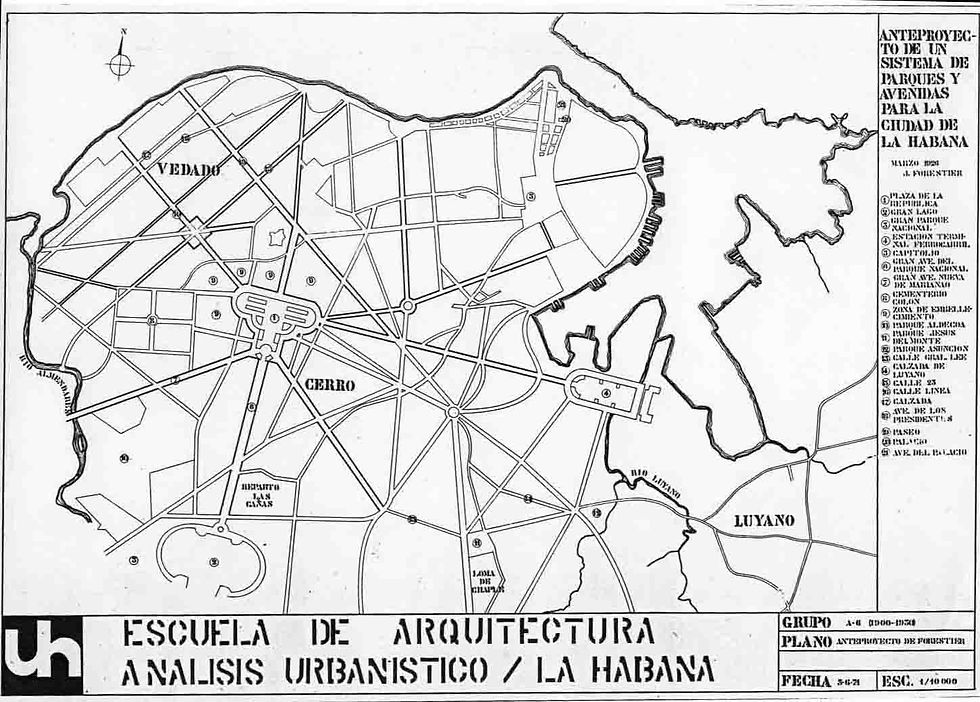
In 1923 and 1924 he worked on an urban plan for Buenos Aires. From 1926 he was in Havana, where he drew a master plan built on a system of parks and grand avenues and designed the gardens of the Capitolio. The Depression of 1929 cut much of it short; the plan remains one of the most complete statements of his ideas.
Lisbon, 1927
In 1927 Lisbon invited him to study its plan. His proposals were not built as drawn, but they informed how the city later thought about its parks and avenues. It was one of his last public commissions; he died in Paris on 26 October 1930.
A Forestier garden in Elvas: the Mistress's Palace
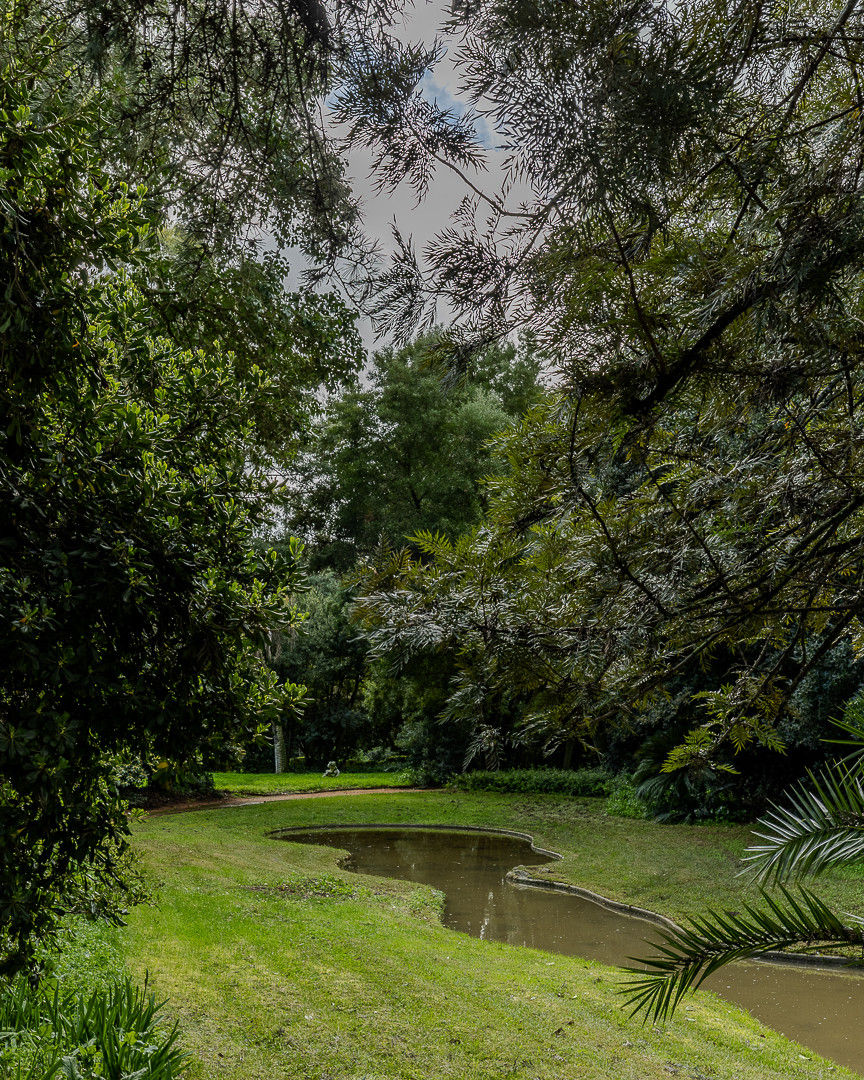
Some of his lineage survives in private hands. Outside Elvas, in the Alto Alentejo near the Spanish border, the Mistress's Palace stands at the centre of a nine-hectare estate. Around the house, built in 1887, about five hectares of gardens in the French manner are attributed to Forestier, among them a formal garden laid out around a reflecting pool. They were restored in 2010 by the Spanish landscape architect Javier Mariátegui. The palace is for sale through Wiseguys Properties: see the Mistress's Palace.

On the ground it reads differently. Ochre paths curve out of sight, a pond appears where the wood opens, palms stand against a grey sky, and a balustraded terrace with its fountain waits at the end of a lawn. It is the element that runs through all of Forestier's gardens, from Bagatelle to Seville: you are never shown everything at once.



What remains
Forestier left no single masterpiece to stand for him, and perhaps that is the point. His work is spread across cities on three continents, often unsigned, folded into the way a street is planted or a park is joined to the next. When a garden of his survives intact, in public or in private, it is a document of that idea, and a rare thing to live with.
For another house whose author deserves to be remembered, read Maison Moderne.
Frequently asked questions
Who was Jean-Claude Nicolas Forestier?
A French landscape architect and urban planner (1861–1930). An engineer trained at the École polytechnique and the forestry school in Nancy, he worked for the City of Paris from 1887 to 1927, and designed parks and city plans in Spain, Morocco, Argentina, Cuba and Portugal.
Which gardens did Forestier design?
Among the best known: the Bagatelle gardens and the Champ-de-Mars in Paris, the Parque de María Luisa in Seville, the gardens of Montjuïc and the Plaça d'Armes in the Parc de la Ciutadella in Barcelona, and the gardens of the Casa del Rey Moro in Ronda.
Did Forestier work in Portugal?
Yes. In 1927 he was invited to study the plan of Lisbon. His proposals were not carried out as drawn, but they informed the city's later planning.
What is Grandes villes et systèmes de parcs?
Forestier's book of 1906, which argued that a city should plan its green spaces as a connected system, from large reserves at the edge to parks, avenues and squares in the centre. It remains a reference in landscape planning.
The Mistress's Palace in Elvas is represented by Wiseguys Properties. For private viewings, or other houses and gardens of this lineage, many of them away from the open market, see our off-market properties or write to us.
Sources: Cité de l'architecture et du patrimoine; Ajuntament de Barcelona. Images: portrait of Forestier, Henri Manuel studio, Paris; street sections for Moroccan towns, J.C.N. Forestier, 1914; Havana plan, University of Havana, school of architecture; garden photography, Wiseguys Properties. Wiseguys Properties, AMI 23109 · info@wgpadvisors.com

Comments