
1830, Written on the Chimney: a House in Reguengos de Monsaraz
The date is not over the door. It is on the chimney.
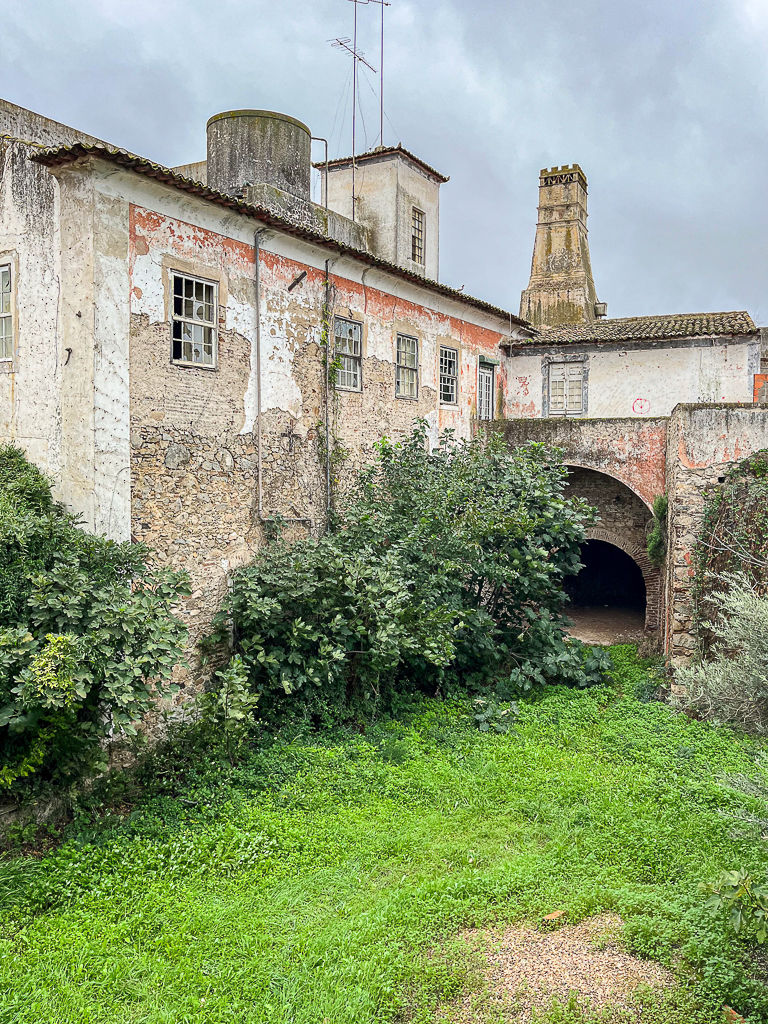
In the centre of Reguengos de Monsaraz, in the Alentejo, a town house wraps itself around a courtyard. Its tallest chimney, square and crowned with small battlements in the Alentejo way, carries a number cut into the plaster: 1830. Two years later, a law student from the region would land at Mindelo with the liberal army. Ten years later, the village around the house would become a town.

A village that became a town
In 1830, Reguengos was still a village under Monsaraz, the walled town on the hill some fifteen kilometres to the east. The liberal wars changed that. In 1838 the seat of the municipality moved down from Monsaraz, and a law of 29 February 1840 made Reguengos its capital. That same year Queen Maria II gave the new town its charter, recalling its people's service to the cause of liberty.
The money came from the land. In the nineteenth century a wool mill founded by José Mendes Papança gave the town its first industry, and the division of the old tenant plots of the House of Braganza opened the way to vineyards. By the end of the century, wine had made Reguengos prosperous.

A liberal, a landowner and a republican, in one neighbourhood.
The Rojão, the Papança and the Gião
The house opens onto a square that bears the name of a José Maria Rojão, and old property records list Rojão neighbours on several sides. The family name belongs to the town's liberal history. José Maria Rojão, born in Mourão in 1801, was studying law at Coimbra when the civil war broke out. He joined the Academic Battalion, landed at Mindelo on 8 July 1832 as one of the 7,500 who began the liberal campaign, rose to major and received the Order of the Tower and Sword. He settled in Reguengos and was president of its council in the 1840s. He married Maria Jacinta Cordeiro Papança in the private chapel of her father.
Her brother, Manuel Augusto Mendes Papança, was mayor of Reguengos and one of its great benefactors. In 1871 he stood as godfather to a boy called Francisco de Salles Fernandes Gião. Gião became an engineer and a landowner, presided over the farmers' syndicate and the Grémio da Lavoura, and in October 1910 was the first president of the town council after the Republic was proclaimed. In the early 2000s, a plan to turn this house into a rural hotel called it Casa Gião.
Another Gião carried the town's name much further. The physicist António Gião, born in Reguengos in 1906 in a house on the Rua Nova, studied in Strasbourg, worked across Europe and taught mechanics and astronomy in Lisbon. A letter from Albert Einstein once reached him at home in Reguengos.
Three families, three revolutions, one square.
Painted ceilings and an oratory
Inside, the house is a sequence of high rooms opening one into the next. The ceilings are painted: garlands, rosettes and ribbons on pale grounds, and birds everywhere, in medallions, in corner cartouches, perched at the centre of a vault. The walls carry painted panels above a dado of blue and white tiles. Some floors are of brick laid in herringbone; others are of timber.


At the end of one enfilade, a small altar stands between twisted Solomonic columns: the domestic oratory, where a household of the period would have said its prayers without leaving home. Upstairs, fireplaces are framed in blue and white tiles. Above the roofs rise the tall Alentejo chimneys, the one with the date among them.


Three buildings and a courtyard
The property is made of three adjoining buildings. The main house has two floors, with twenty-six rooms in the property register. A single-storey wing, reached through the garden, adds twelve rooms and was once part of the same house. A third building of 180 m², recorded as a wine store, closes the group. Together they come to 1,441 m² of built area around 477 m² of courtyard and garden.

The house has been sold through Wiseguys Properties: see its page. For another Alentejo house in the Journal, read about the Mellos Josés Palace in Elvas or the house where Nisa embroiders.
Frequently asked questions
When was the house built?
The date 1830 is carved on one of its chimneys.
Where is it?
In the centre of Reguengos de Monsaraz, in the Alentejo, some fifteen kilometres from the medieval village of Monsaraz.
What does the property include?
Three adjoining buildings: a two-storey main house, a single-storey wing with twelve rooms and a 180 m² wine store, with 1,441 m² of built area and 477 m² of courtyard and garden.
Who were the Gião of Reguengos?
A local family of landowners. Francisco de Salles Fernandes Gião (1871–1955) was the first president of the town council after the 1910 Republic; the physicist António Gião (1906–1969) was also born in Reguengos.
Is the house for sale?
No. It has been sold through Wiseguys Properties.
Further reading: Farmhouse for Sale in Portugal: Buying a Monte in the Alentejo.
Sources: Arquivo Municipal de Reguengos de Monsaraz (José Maria Rojão; Francisco de Salles Fernandes Gião; António Gião); Junta de Freguesia de Reguengos de Monsaraz, História; Gazeta de Física. Photographs: Wiseguys Properties.


Comments