
Farmhouse for Sale in Portugal: Buying a Monte in the Alentejo
In the Alentejo, a house never comes alone. It comes with its land.
Anyone searching for a farmhouse for sale in Portugal ends up, sooner or later, in the Alentejo. It is the largest region of mainland Portugal: plains of wheat and vines, cork and holm oaks, white hamlets and very few people. Its farmhouses go by several names, and each name says something about the land around them. This guide sets out the vocabulary, the architecture and, above all, what to check before you sign, with examples from properties we know between Portalegre, Alqueva and the coast.

Monte, herdade, quinta: a vocabulary of land
A herdade is a large rural estate, the classic unit of property in the south. The monte is its built heart: the house of the owner or the overseer, with barns, stables, a bread oven and a threshing floor. The word also means hill, and many montes do stand on a rise, watching over the fields. A quinta, a word used all over Portugal, is a farm with a house, usually smaller and closer to a town. A courela is a narrow strip of farmland. And the villages called Foros recall the aforamentos, plots held by small farmers under a perpetual lease against a yearly rent, until that regime was abolished for rural land in 1976.
The words travel beyond the region, and it helps to know where the region ends. An estate such as Casal Riba Tejo, on the Tagus at Mouriscas, near Abrantes, is a quinta in every sense, but it belongs to the Médio Tejo, not to the Alentejo. The difference matters when you read a planning map or a regional programme.
Whitewash, earth and brick
The monte is built from what the ground offers. Walls are thick, of stone or rammed earth (taipa) depending on the area, and covered in lime whitewash that was traditionally renewed every year, often finished with a painted band, blue or ochre, at the base and around doors and windows. Openings are few and small, a defence against the summer sun. Above the roofs rise the wide Alentejo chimneys, which a house in Reguengos de Monsaraz used to carry its date: see 1830, written on the chimney.
Inside, the surprise is often overhead. In a recent study, the art historian Ana Costa Rosado describes brick vaults as a distinguishing feature of even the most common houses of the inner Alentejo, something almost unique in Portugal. The great survey of Portuguese vernacular building, the Inquérito à Arquitectura Popular em Portugal, published by the architects' union in 1961, recorded these houses, their vaults and their chimneys in detail.
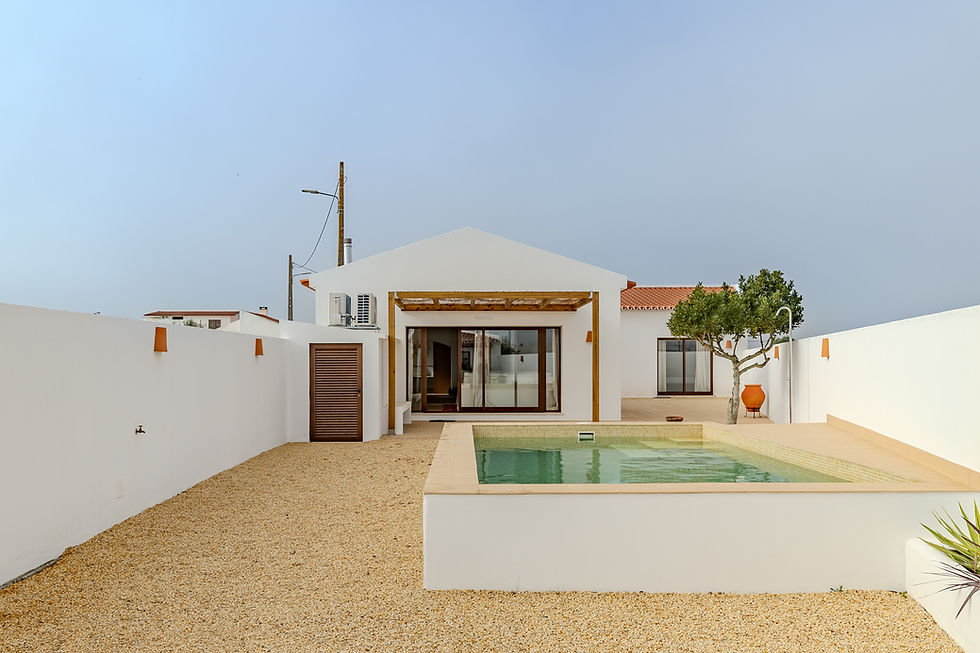
Around the house lies the working landscape: the eira, a paved threshing floor; the well, sometimes with its nora, the water wheel once turned by a mule; and the montado, the open woodland of cork and holm oaks grazed by cattle, sheep and pigs. The cork oak is more than a tree here. In 2011 the Portuguese Parliament declared it the national tree.

Five Alentejos
The Alto Alentejo, around Portalegre, rises towards the Serra de São Mamede: greener and more broken ground, with smaller plots. It is the country of the Portalegre theatre and of manor houses in town, such as The Great Green House, a restored house with a garden on the edge of the hills. Further south, Évora and Reguengos de Monsaraz form the Alentejo of vines and marble, with Estremoz and Borba close by, and Elvas on the frontier, where the Mellos Josés Palace stands.
Alqueva is a landscape made in our own time. The dam on the Guadiana closed its gates on 8 February 2002 and created a reservoir of about 250 km², often described as the largest artificial lake in Western Europe; the village of Aldeia da Luz was rebuilt on a new site. Its shores follow a special plan, drawn up in 2002 and revised in 2006, which a new programme agreed in January 2026 is set to replace. The Alentejo coast, from Grândola and Melides to Odemira, is another market altogether, discussed in our guide to Comporta and Melides. The Baixo Alentejo, around Beja, Mértola, Moura and Serpa, is the widest and quietest of all.

Before the house, look at the trees.
What to check before you sign
Start with the nature of the property. A farm can be a rural property (prédio rústico), an urban one or a mixed one (prédio misto), each with its own entries in the tax register, the caderneta predial, and in the land registry. On old estates, the areas on the caderneta, in the registry and on the ground often disagree. A survey by a topographer, and a careful reading of the boundaries, is money well spent; see also our note on BUPi and rural land.
Then ask what can be built. The municipal master plan (PDM) classifies each piece of land as urban or rustic, and on rustic land new building is the exception: plans usually set a minimum plot size and maximum areas for a house. Restoring an existing monte is generally easier than building anew. Land in the national agricultural reserve (RAN) or ecological reserve (REN), or inside a Natura 2000 site, carries further limits, and rural land cannot be divided freely below the legal minimum unit. A formal request for prior information (pedido de informação prévia) to the municipality is the surest answer.
Look at the trees. Under Decreto-Lei 169/2001, cutting or uprooting a cork oak or a holm oak, in a stand or standing alone, requires authorisation from the forestry authority, and stands cannot be converted to other uses except in narrow cases. Where trees were cut illegally, the land can be barred from construction and new activities for 25 years. A montado is a pleasure to own; it is also a responsibility.
Finally, water, power and access. Wells and boreholes fall under the Water Law and are managed by the Portuguese Environment Agency (APA); depending on the power of the pump, a new one needs either a prior communication or a permit, and an old one should be checked. Ask how far the grid is, who maintains the track to the house and whether any right of way is registered.
Rural tourism, as a hypothesis
Many buyers picture a monte with guests. Portuguese law offers several routes: houses in the country (casas de campo), agritourism on a working farm, rural hotels, and turismo de habitação in houses of architectural or historic value. The municipality classifies the first two and turismo de habitação; Turismo de Portugal classifies rural hotels. Alojamento local is a lighter alternative. Our guide to alojamento local and rural tourism explains the differences.

Treat tourism as a hypothesis until the municipality confirms it. The listing of the Alqueva plot, for instance, indicates a potential of up to 500 m² for a private house and up to 2,250 m² of occupation for rural tourism, subject to licensing and local approvals. On the coast, Casetas de Melides is presented as a lifestyle and rural tourism property, with a main house and six timber casetas among the olive trees.
Wiseguys Properties has a 33-hectare plot near Alqueva, in Portel, among its Alentejo properties. If you own a monte, a herdade or a quinta and are thinking of selling, tell us about it.
Frequently asked questions
Can a foreigner buy a farm in the Alentejo?
Yes. Portugal does not restrict the purchase of rural or urban property by foreigners. A Portuguese tax number (NIF) is required.
What is the difference between a monte and a herdade?
The herdade is the estate, the land. The monte is its group of buildings: the house, barns and yards at the centre of the farm.
Can I build a house on rustic land in the Alentejo?
Only if the municipal master plan allows it, usually with a minimum plot size and maximum built areas. RAN, REN and Natura 2000 add limits. Restoring an existing building is generally easier.
Can I cut down cork oaks on my land?
Not freely. Cutting or uprooting cork and holm oaks requires authorisation under Decreto-Lei 169/2001, and illegal cutting can block building on the land for 25 years.
Do I need a permit for a borehole?
Wells and boreholes are regulated by the Water Law. Depending on the power of the pump, a new one requires a prior communication or a permit from the Portuguese Environment Agency.
This article is general information and does not replace legal or tax advice. Sources: Decreto-Lei 169/2001, as amended by Decreto-Lei 155/2004; Resolução da Assembleia da República 15/2012; Decreto-Lei 39/2008 and Portaria 937/2008; Turismo de Portugal, classification of tourist establishments; Lei 58/2005 and Decreto-Lei 226-A/2007; Ana Costa Rosado, Revista de História da Arte 19 (2025); Inquérito à Arquitectura Popular em Portugal (1961); ECO, 17 January 2026. Photographs: Wiseguys Properties.
Comments