
Portalegre: The Great Green House and the Woman Who Recorded the Tiles
From the street, it gives almost nothing away.
In the historic centre of Portalegre, a town house of cellar, two floors and attic keeps a plain face to the street. Behind it lies a walled garden of 605 m², with stone paths, a fountain and a pool; inside, a blue drawing room, a deep blue corridor, a library and an ivy-green kitchen. We call it The Great Green House. From at least 1991 until her death in 2019, it belonged to Teresa Saporiti, the artist who spent much of her life photographing and recording the azulejos of the Portalegre district. This is a portrait of the house, and of her.

A plain front, a hidden garden
Old Portalegre built its houses this way: a sober front on a narrow street, and depth behind. This one stands in the former parish of São Lourenço, in the heart of the old town. The property register describes a house of cellar, ground floor, first floor and attic, with a garden: 922 m² of land, of which 317 m² are built and 605 m² open to the sky. Like many houses in the city, it once kept a shop on the ground floor, and in 1991 the council licensed a room there for trade.
The name describes what the street does not show. Green is the colour of the garden, of the mature planting that fills it, and of the kitchen that looks onto it.
Teresa Saporiti, 1937 to 2019
Maria Teresa Côrte-Real Saporiti Machado was born in Portalegre in 1937, in the parish of São Lourenço. She studied painting at the Escola Superior de Belas-Artes in Lisbon, took a course at IADE and did postgraduate work in printmaking at the Slade School of Fine Art in London. She drew, painted, made prints and photographed. Above all, she looked at tiles.
From 1982 to 1991, with Ana Lopes de Almeida and the support of the Gulbenkian Foundation, she recorded the façade and outdoor tiles of Lisbon from the late nineteenth and early twentieth centuries: 3,011 buildings, 6,878 slides. Books followed, almost all bilingual and several published at her own expense: Lisbon tiles of the twentieth century (1992); a study of Luís Ferreira, the painter known as Ferreira das Tabuletas (1993); twentieth-century Portuguese patterns (1998); and two volumes on the tiles of Eduardo Nery (2000 and 2013). Our guide to Portuguese tiles tells the longer story she was documenting.
The tiles of a district
Then she turned to home. Azulejaria do Distrito de Portalegre, published in 2006, runs to nearly four hundred pages, in Portuguese and English, with photographs by Raul Ladeira. Her slide inventory of the district is now part of the DigiTile collection of the Gulbenkian Art Library, ordered by municipality and by building, each entry noting place, date, author, factory, style, dimensions and condition. Among the images: the chapel of Santo António dos Olivais at Alter do Chão, the parish church of Santiago at Castelo de Vide, the Misericórdia of Elvas, and the railway station of Marvão, at Beirã.
In 2008 came a book on a single building, the tiles of the Monastery of São Bernardo in Portalegre. The monastery was founded in 1518 by Jorge de Melo, bishop of Guarda, for Cistercian nuns. His tomb, by Nicolau Chanterene, is carved in Estremoz marble, and the church walls carry eighteenth-century panels of the life of Saint Bernard.
An inventory is a quiet form of devotion.
Portalegre noticed. On 23 May 2014 the town council awarded her its Medal of Municipal Merit. On 15 May 2026, seven years after her death, the Politécnico de Portalegre opened an exhibition of her photographs, with the support of the council, presenting her as an artist and researcher of the city.
Blue rooms, a library, a green kitchen
Inside, the house keeps the proportions of an older Portalegre: high ceilings, stucco work and a marble fireplace in the blue drawing room. Its date of construction is not recorded in the documents we have seen, and we will not invent one. A deep blue corridor leads to the library, lined with shelves from floor to ceiling. The original floorboards have been repaired, and textured papers dress some of the walls.

The kitchen is the house's most contemporary room and its greenest: Estremoz marble, cabinets lacquered in ivy green, brass fittings and a cream and brass Meireles range. There are four bedrooms, three of them en suite. In all, the house has 784 m² of gross construction area, about 630 m² of it private, across twenty-three rooms.

The recent rehabilitation is on the record. In October 2025 the Câmara Municipal de Portalegre certified that the building, inside the town's urban rehabilitation area, had been rehabilitated to an excellent state of conservation, at least two levels above its previous one, for the purposes of the tax benefits for urban rehabilitation. A buyer should confirm with a tax adviser what applies to their own purchase. The energy certificate is B-.
The walled garden
The garden is the heart of the house. Stone paths and mature planting divide it into a sequence of spaces, one leading into the next, with a sculptural fountain and, at the far end, a private pool. From the garden the house shows a different face, with large openings and balconies onto the garden. It is a rare thing in a historic centre: 605 m² of private green behind a street front.
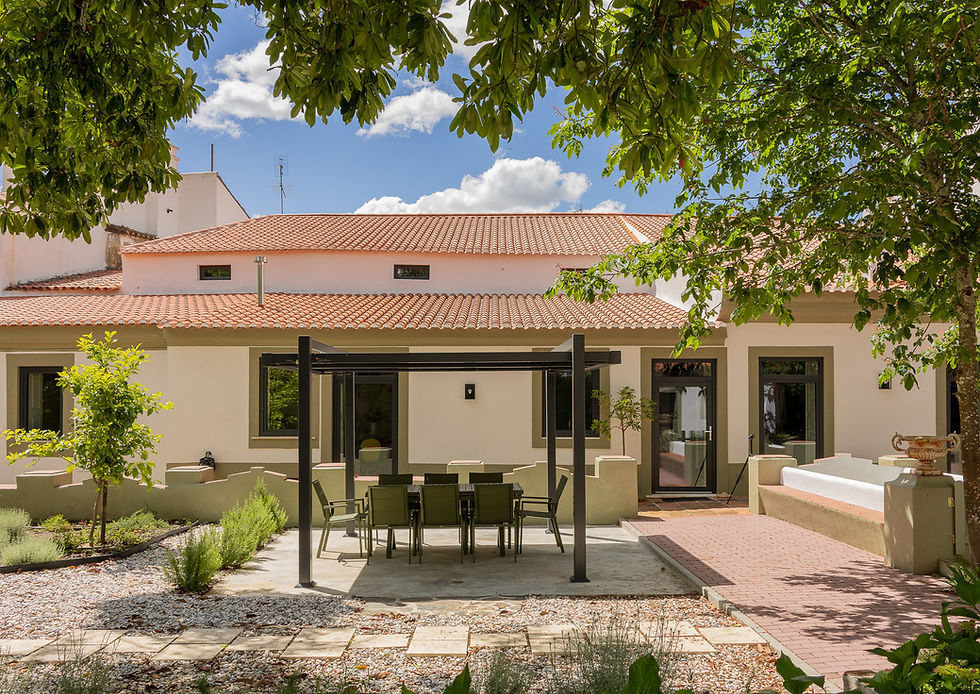

The house today
Portalegre sits at the foot of the Serra de São Mamede, about two hours from Lisbon, half an hour from Spain and twenty-five minutes from Marvão and Castelo de Vide. It is a city of convents and of tapestry, and the Journal has told the story of its nineteenth-century theatre and of Nisa's embroiderers, nearby. The Great Green House is for sale through Wiseguys Properties: the listing has the full details and photographs, and WGP Advisors would be glad to arrange a visit.
Frequently asked questions
Who was Teresa Saporiti?
A Portuguese artist and tile researcher, born in Portalegre in 1937 and died in 2019. She inventoried the façade tiles of Lisbon and the azulejos of the Portalegre district and published several books on them.
What is the connection between Teresa Saporiti and the house?
The house belonged to her from at least 1991 until her death in 2019.
Where can I see her inventory of Portalegre tiles?
Her slide inventory of the district is part of the DigiTile collection of the Gulbenkian Art Library, in Lisbon, which shows a selection online.
How large is the garden?
605 m², walled, with stone paths, a sculptural fountain and a private pool.
Is The Great Green House for sale?
Yes, through Wiseguys Properties. The listing on our website has the details, and visits can be arranged.
Sources: Fundação Calouste Gulbenkian, Biblioteca de Arte, DigiTile (Inventário da azulejaria do distrito de Portalegre; Azulejaria de Lisboa); Biblioteca Nacional de Portugal, catalogue records for Teresa Saporiti; Centro Português de Serigrafia, artist biography; Rádio Elvas, 14 May 2026; Infopédia, Convento de S. Bernardo; Câmara Municipal de Portalegre, rehabilitation certificate (2025). Photographs: Wiseguys Properties.


Comments