
Portalegre, Portugal: A New Chapter for an Old City
A city of tapestries is learning a new trade.
Portalegre, Portugal, sits at the foot of the Serra de São Mamede, about two hours by road from Lisbon and half an hour from the Spanish border. It is a city of convents and town houses, of cork, mountain wine and a tapestry workshop that wove for Jean Lurçat. In 2026 it is also becoming something new: an Iberian gateway for industry and technology. A defence and technology cluster has made its base here, a motorway for the IP2 is on the national priority list, a new railway to Spain has been built through the district, and a factory, a hospital unit and new student residences are adding to the city. For anyone thinking of investing in the Alentejo, or of living in an old city with fresh momentum, this is the whole picture.
A city with new momentum
Seen together, the projects point in one direction. Private investment is arriving in industry: a PET film factory with 154 jobs, and a cluster that has already signed its first contract, with an aviation and drone company. Public investment is improving the way the city connects and cares for people: a motorway corridor towards the A23 and the A6 in preparation, a railway built for 250 km/h in the district, a new intensive care unit at the hospital. Knowledge grows alongside. Since 1 August 2026 the city's higher education institution has been the Universidade Politécnica de Portalegre, and its student housing is expanding beyond 760 beds.
None of this replaces what Portalegre already is. It adds to it. The historic centre, the Serra on the horizon, houses with real proportions and walled gardens remain the city's first assets. What changes is the number of people with a reason to come, to work and to stay.

An Iberian hub for defence and technology
The Industrial Portugal Gateway was presented on 25 September 2026 at the premises of NERPOR, the business association of the Portalegre region, which is its territorial partner and operational base. Promoted by Luso Defense Group, it is conceived as an Iberian cluster for defence, security and dual-use technologies. The sectors it targets read like a map of the industries now in demand across Europe: unmanned systems, robotics, artificial intelligence, communications, cybersecurity, civil protection, surveillance, mobility, engineering and industrial components.
Its role is practical. A team of about fifteen people guides companies, many of them from outside Europe, through site selection, licensing, financing and recruitment, working with the fifteen municipalities of the district, the intermunicipal community CIMAA and the regional authority, CCDR Alentejo. The platform started with several letters of intent, and Lusa reported advanced talks with companies from Malaysia, Thailand, China and Cyprus.
The first contract is already signed. It brings a Malaysian aviation and drone company to the Alto Alentejo, with an estimated initial investment of €10 million to €20 million, to be set by its feasibility study and business plan. Production is expected about two years from the first phases, and the location is being chosen together with CIMAA and the municipalities. In October 2026, ECO summed it up in a headline: drones from Malaysia are flying to the Alto Alentejo.
The cluster will also have its own stage. The Iberian Defence Expo, a biennial international fair for defence, security, dual-use and strategic industry, will hold its first edition from 22 to 25 September 2027 at NERPOR, in Portalegre. Every two years, exhibitors, delegations and buyers from across Iberia and beyond will have a reason to book a room in the city.
For Portalegre, the meaning is concrete. Industries of this kind need qualified people: engineers, technicians, software and maintenance specialists. They need local suppliers, which NERPOR's member companies are well placed to become, and training, for which a polytechnic university in the same city is a natural partner. They bring visitors to hotels and restaurants. And they bring new residents who will look for houses, schools and services in a city that has room for them.
Closer to Lisbon and Madrid
In March 2025 a Council of Ministers resolution placed the IP2 in motorway profile between Portalegre and Estremoz on the list of the country's new priority roads. On 31 March 2026 Infraestruturas de Portugal launched the tender for the preliminary study of the link between the A23 and the A6 along the IP2 corridor, some 100 km from the A23 near Fratel down to Estremoz, through Nisa, Crato, Portalegre and Monforte. The study has a base price of €2.5 million and 660 days to run. Once built, the corridor will connect Portalegre by motorway both to Castelo Branco and the north, and to Évora and Lisbon.
The IC13, from Montijo to Alter do Chão through Coruche, Mora and Ponte de Sor, is on the same priority list, and the tender for its preliminary study was published on 19 March 2026. To carry the list forward, the government plans new road concessions between 2029 and 2031.
The railway is further ahead. The new line from Évora to the border at Caia, near Elvas, part of the southern international corridor from the port of Sines to Spain, was completed in January 2026, an investment of almost €460 million. It is the first line in Portugal built for 250 km/h, for both freight and passengers. The line is now being certified, with entry into service pointed to early 2027.
The Serra stays. The horizon widens.
The horizon is Madrid. The government's targets are a journey of about five and a half hours by train between 2028 and 2030, and three hours by 2034. The line runs through Portalegre's own district, at Elvas, a city of fortifications and palaces such as the Mellos Josés palace.
Industry, health and knowledge
Evertis Ibérica will build a factory in Portalegre for PET film used in food and healthcare packaging, an investment of about €39.5 million with 154 direct jobs at full operation. The government classified it as a project of special interest for the national economy and approved €11.8 million in support in December 2025.
At the Hospital Dr. José Maria Grande, part of the ULS do Alto Alentejo, a new polyvalent intensive care unit for twenty patients has been receiving them since June 2026, and the mental health department, renovated with recovery-plan funds, reopened on 30 April 2026. Together, about €10.2 million: the kind of investment that matters to any family deciding where to live.
The Universidade Politécnica de Portalegre, the former Instituto Politécnico, is growing its student housing beyond 760 beds, with about €15 million largely from the recovery plan. The Abrunheira residence, with 203 beds in 44 apartments, is open, and the former Palacete do Visconde dos Cidraes, on Rua 5 de Outubro, is becoming a residence of 79 beds. An old town house given a new life by students is a good image of the city as a whole.
Incentives for those who arrive
The whole municipality of Portalegre, like the rest of the district, is classified as a low-density territory under Portaria 208/2017. Under article 41.º-B of the Tax Benefits Statute, small and medium-sized companies pay corporate tax at 12.5% on their first €50,000 of taxable profit, and the costs of net job creation count at 120%. Families benefit too: whoever moves their permanent residence to an interior territory can deduct up to €1,000 a year of rent from IRS for three years. For the taxes on the purchase itself, see our guide to the cost of buying a house.
What this means for buyers
A city that attracts engineers, doctors, lecturers and students is a city where good houses are wanted, and where restaurants, shops and services find their public. Portalegre offers what many of them will look for: a historic centre with town houses of real scale, gardens behind walls, the Serra de São Mamede at the edge of town, Marvão and Castelo de Vide twenty-five minutes away. Its culture runs deep, from the tapestries we describe in Portalegre, city of tapestries to the Teatro Portalegrense. For the steps of a purchase, see buying property in Portugal, step by step, and for a comparison across regions, what one million euros buys outside Lisbon.

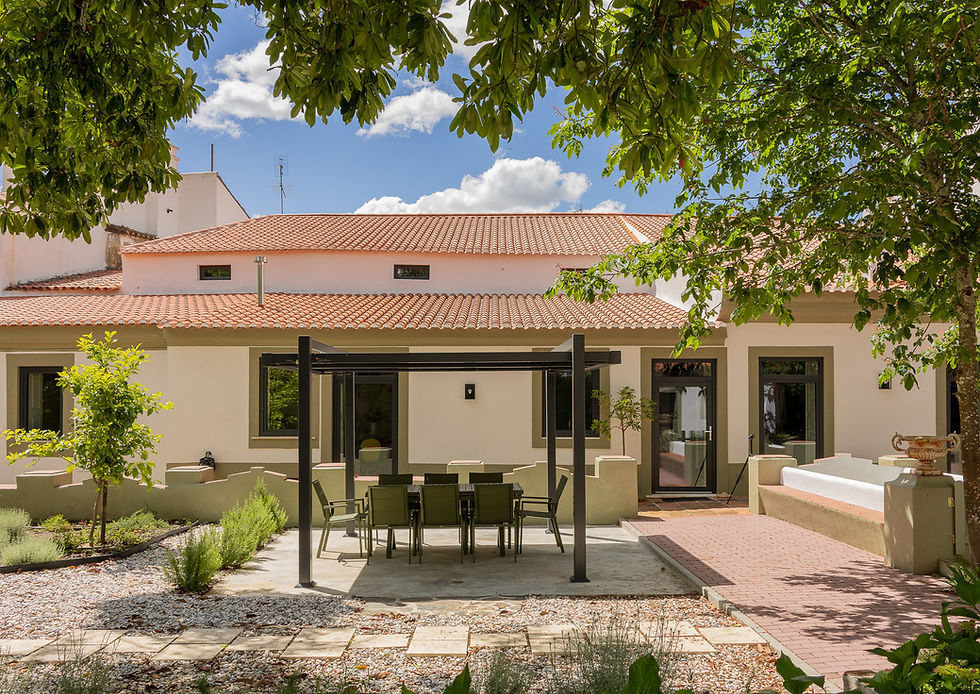
The Great Green House shows what the historic centre can offer. It stands in the old parish of São Lourenço, on a plot of 922 m² with a walled garden of 605 m², stone paths, a fountain and a private pool. It has about 630 m² of private area, four bedrooms, three of them en suite, and an energy rating of B-. The house lies within Portalegre's urban regeneration area, and in October 2025 the Câmara certified that its rehabilitation had raised its state of conservation to excellent, for the purposes of article 45 of the Tax Benefits Statute, a point a buyer can review with their adviser. Inside: Estremoz marble in the kitchen, a library with shelves from floor to ceiling, original floors carefully repaired. It belonged, from at least 1991 until her death, to Teresa Saporiti, the artist who spent decades recording the azulejos of the district. We tell that story in the house of Teresa Saporiti.

Wiseguys Properties advises buyers of historic houses across the Alentejo, from The Great Green House to a nineteenth-century theatre in the same city. To visit Portalegre with us, or to talk about what the city's new chapter could mean for you, contact us.
Frequently asked questions
What is the Industrial Portugal Gateway?
An Iberian cluster for defence, security and dual-use technologies, presented in September 2026 and based at NERPOR in Portalegre. Its first contract, with a Malaysian aviation and drone company, carries an estimated initial investment of €10 million to €20 million.
When is the Iberian Defence Expo?
The first edition will take place from 22 to 25 September 2027 at NERPOR, in Portalegre. The fair is planned every two years.
How far is Portalegre from Lisbon and Madrid?
About two hours by road from Lisbon and half an hour from the Spanish border. The new Évora-Caia railway is built and preparing to enter service, with Madrid targeted at about five and a half hours by 2028 to 2030 and three hours by 2034.
Will the IP2 between Portalegre and Estremoz become a motorway?
It has been on the national priority list, in motorway profile, since March 2025, and the preliminary study of the A23-A6 corridor was put out to tender in March 2026.
Are there tax incentives for moving to Portalegre?
Yes. Portalegre is a low-density territory: small and medium-sized companies pay reduced corporate tax, and people who move their permanent residence there can deduct up to €1,000 a year of rent for three years.
General information as of October 2026; it is not investment, legal or tax advice. Sources: Government of Portugal, communiqué on priority roads (11 March 2025); ECO (16 January, 19 March, 1 July, 1 September and 7 October 2026); Observador and Lusa (31 March, 19 June and 27 July 2026); Lusa (1 September 2026); Rádio Portalegre (19 March 2026); Jornal Alto Alentejo (2 January, 18 June and 25 September 2026); Rádio Elvas (27 August 2026); Tribuna Alentejo (7 July 2026); Portaria 208/2017; Estatuto dos Benefícios Fiscais, article 41.º-B. Photographs: Wiseguys Properties.


Comments